Designing an Estate Plan Drafting System for Solo Attorneys
Summary
I joined Keepsake pre-launch a designer/developer and later led product. After a B2B pivot and founder exit, I helped reconnect the product to attorney workflows.
I defined and designed a missing draft-generation system essential for adoption, while managing a five-person engineering team to deliver it.
Company
Keepsake
Role
Product Designer
Timeline
Nov 2024 - Feb 2025
Background
Keepsake helped estate planning attorneys streamline client intake and transform client information into draft estate planning documents such as wills and trusts.
The Start
Keepsake began as a B2C estate planning app helping individuals and families create estate plans. While the concept resonated emotionally, the team struggled with monetization and user acquisition.
The Pivot
The team recognized attorneys were already guiding clients through this process and could become a distribution channel for broader adoption. The company shifted to B2B, targeting solo estate planning attorneys.During this transition, the founding team stepped away, leaving product direction unclear.
My Role
I joined pre-launch to help rebuild the product around the B2B model and reconnect it with real attorney workflows. A critical “plan design” feature — turning intake data into usable legal drafts — was only partially defined, preventing beta attorneys from adopting the platform.
Alongside the CTO, I managed product priorities, defined requirements, and guided engineering decisions toward a launch-ready application.
Problem
Attorneys weren’t adopting the product
The application itself was fully functional, and we had a waitlist of attorneys generated through months of cold outreach.
Although several attorneys completed onboarding, they abandoned the workflow before entering client information. The challenge wasn’t building more features, it was understanding the missing workflow layer preventing attorneys from seeing Keepsake as part of their practice.
Goal
How do we move from built to launch-ready?
- Identify the critical gaps preventing attorney adoption
- Align the product with real drafting processes
- Validate that attorneys could integrate Keepsake into their existing practice workflows
Constraints
- No dedicated PM
- Limited runway
- A backend-driven roadmap
- Limited access to legal domain expertise
- Complex workflows with attorney-specific variations
Discovery
Understanding Attorney Workflows
- Conducted Zoom interviews with waitlisted attorney clients
- Analyzed clients’ PDF intake forms and drafting documents
- Audited competitor products and compiled analysis
With our findings, I mapped the end-to-end user flow of attorneys and their clients.
Attorney Flow

Client Flow

Insight 1
Many competitors existed for client intake
While Keepsake originally differentiated itself through digital client intake, the market had evolved. Many competitors now offered tools to help attorneys collect client information and manage estate planning workflows.
Keepsake originally aimed to replace fragmented intake processes like PDFs and Google Forms. While the product provided a better user experience for collecting client information, competitors and existing tools all shared the same limitation: they stopped before transforming intake data into a complete estate plan.
Insight 2
Adoption depended on closing the gap between intake and drafting
Attorneys didn’t need another intake tool. They needed a system that reduced the time and effort between client conversations and completed estate plans.
Keepsake’s MVP handled client intake, but the workflow stopped there. Attorneys still had to manually turn intake responses into legal drafts. Meanwhile, competitors were beginning to address this gap through draft-generation features or integrated drafting services, increasing the urgency to support the full workflow.
Insight 3
Estate planning workflows required flexibility
Attorney workflows varied widely. Each practice:
- Had unique intake forms (including custom languages)
- Required different logic for post-intake drafting.
Some drafted collaboratively with clients, others handed forms to a drafter, and some didn’t use a formal design document at all.
A single standardized template would have increased friction rather than reduced it.
The Refined Problem
Keepsake aimed to bridge both the legal and personal sides of estate planning, but it emphasized intake mechanics without supporting the drafting workflows attorneys actually needed.
The platform wasn’t missing a feature. It was missing a complete layer of the workflow.
Solution
Designing flexible intake
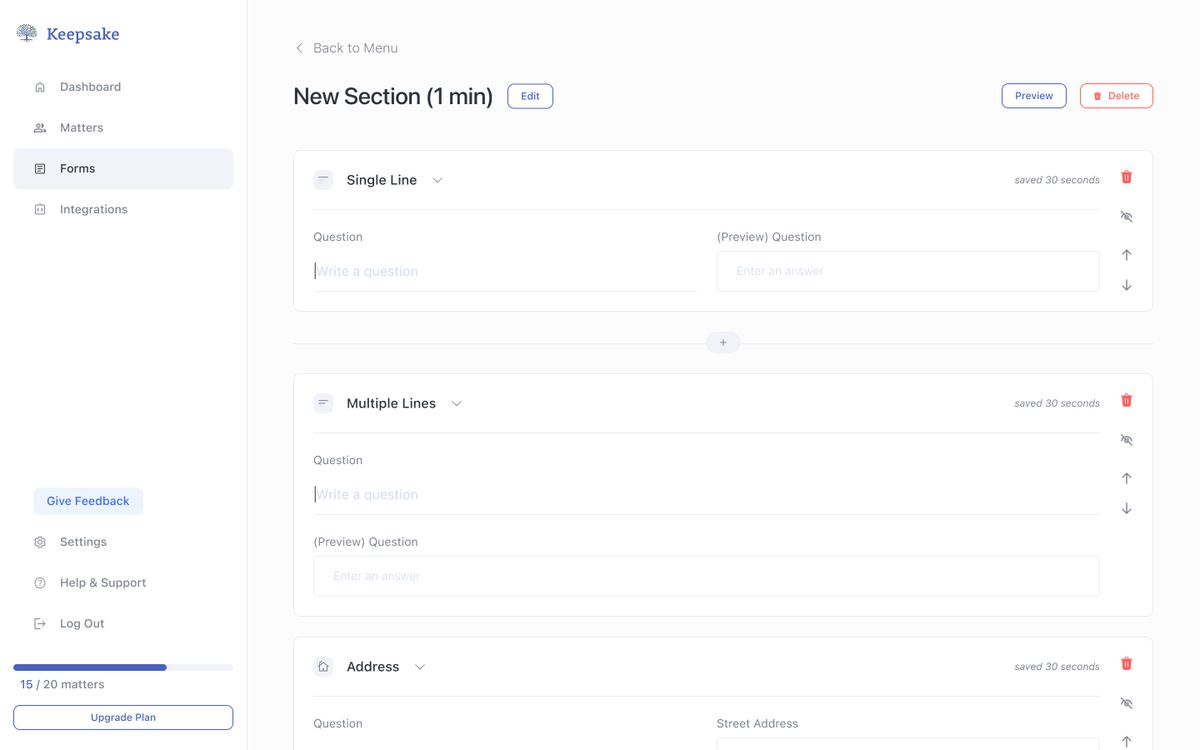
Intake fields needed to translate into structured legal outputs, so sections on assets, beneficiaries, trustees, etc. required conditional logic.
We manually recreated intake forms in the app for 3 beta customers, and structured them to test repeatable logic.
The “plan design” feature
I defined requirements for the critical “plan design” system that enabled legal draft generation.
I additionally refined and expanded the Figma-based design system left by the founding designer, and managed engineering priorities and product direction using Linear.
I also contributed UI improvements directly in the codebase and contributed PR Reviews in github.
Forms in Keepsake
Conclusion
Impact
- Clarified product direction and defined requirements for the draft-generation system
- Re-established a direct user feedback loop with attorneys
- Identified architectural needs to support scalable customization
- Enabled two attorneys to adopt the platform and successfully onboard new clients using it
Learnings
- Early-stage product success requires a clear vision and leadership. Even strong teams can struggle to communicate value and gain adoption without it.
- Surface-level feedback isn’t enough. You must follow users through their actual workflows to understand how a product truly fits.
- Dedicated alpha testing with a small, controlled group is essential before engaging beta customers.
I joined Keepsake as the sole designer and assumed head-of-product responsibilities, guiding both design and development. Overall, this was a valuable opportunity to work with a very talented team. Thanks to Sabih, Yohance, Cade, and everyone for your passion and hard work:)
Next Project